
1. The Limits of Frontier APIs
Proprietary frontier APIs offer impressive zero-shot generalization, but they impose severe architectural constraints on production engineering teams: high token pricing, unpredictably changing behavior on upstream model updates, latency bottlenecks, and zero data sovereignty.
Optimization theory and the No Free Lunch Theorem mathematically demonstrate that resource concentration beats generalist compromise. In complex enterprise workflows, generalist models suffer from negative transfer—where unrelated training domains compete for representational capacity, diluting accuracy on mission-critical edge cases.
2. The Pillars of Model Sovereignty
Own the Loop, Not the Snapshot
Frozen snapshots degrade over time. Sovereignty requires automated dataset ingestion and an active fine-tuning engine to continuously update weights as business data evolves.
Task-Specific Beats Generalist
Compact, specialized models fine-tuned specifically on domain workflows eliminate negative transfer, outperforming trillion-parameter models at a fraction of latency and cost.
Zero Infrastructure Tax
Operating a fleet of custom models usually demands dedicated MLOps teams. AlphaDeep’s JAX-native Blinx kernel serves thousands of adapters on single TPU/GPU clusters with zero cold starts.
3. Quantitative Comparison: Frontier API vs. AlphaDeep Custom
When benchmarked across real-world enterprise tasks, task-specific models consistently deliver superior domain accuracy and order-of-magnitude reductions in latency and token expenditure:
Domain fine-tuning removes generic ambiguity and eliminates negative transfer.
Compact single-task adapters run directly on TPU/GPU without router overhead.
Pay only for precise tokens generated, hosted on dense multi-adapter clusters.
4. Industrial Case Study: Real-Time Defect Detection
AlphaDeep deployed in production at a global industrial manufacturer (specializing in tire and agricultural wheel systems) to automate defect classification across active conveyor belts.
Using our agentic data labeling and LoRA convergence pipeline, a vision model was fine-tuned on just 120 defect images (tears, bubbles, seam misalignments). Inference was deployed directly to factory-floor edge systems with real-time cloud telemetry. Low-confidence classifications automatically triggered human-in-the-loop review, and verified annotations were looped back to continuously update the weights.
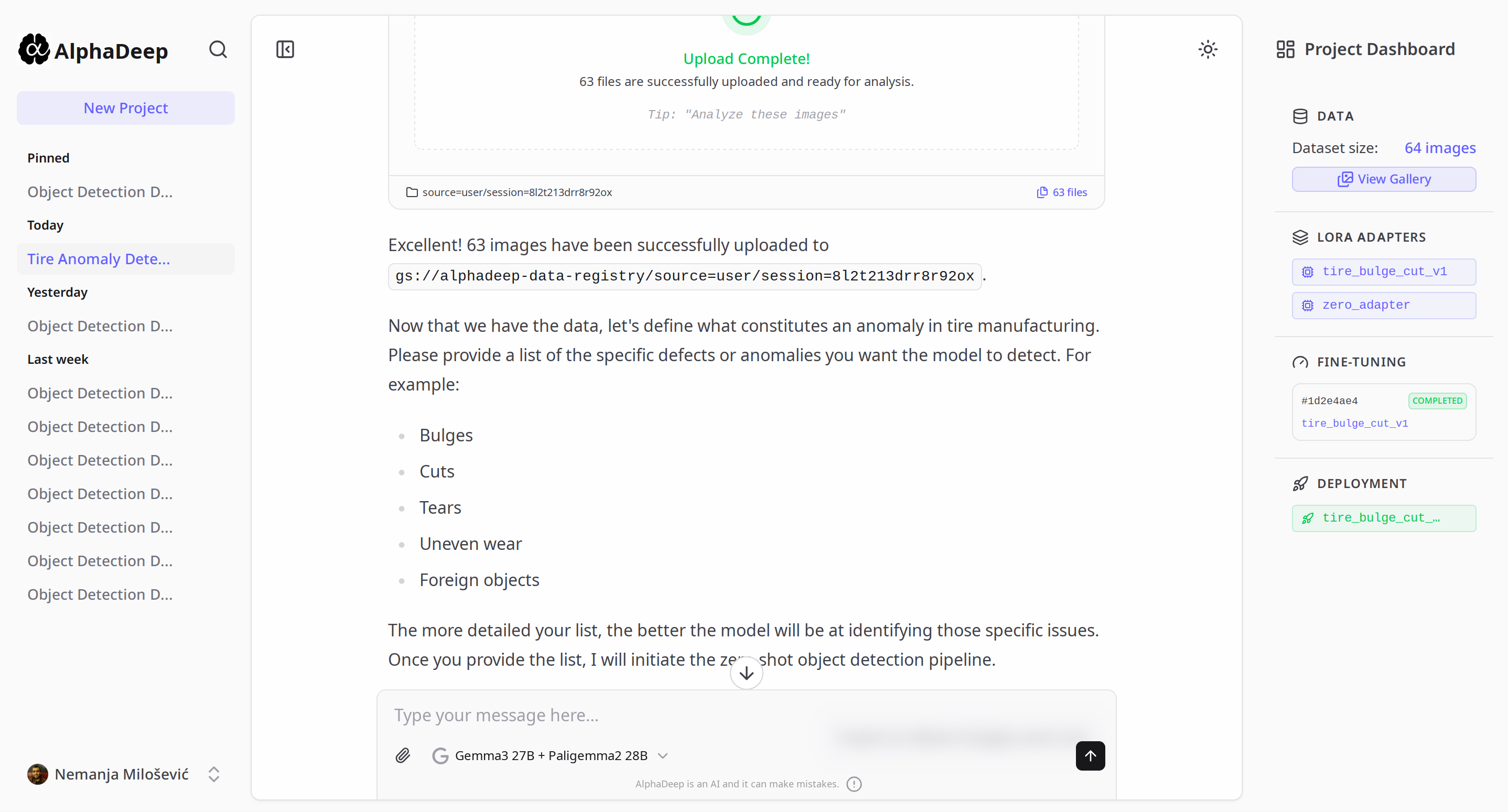
Industrial Inspection Hub
Live anomaly detection running on factory conveyor belt cameras.
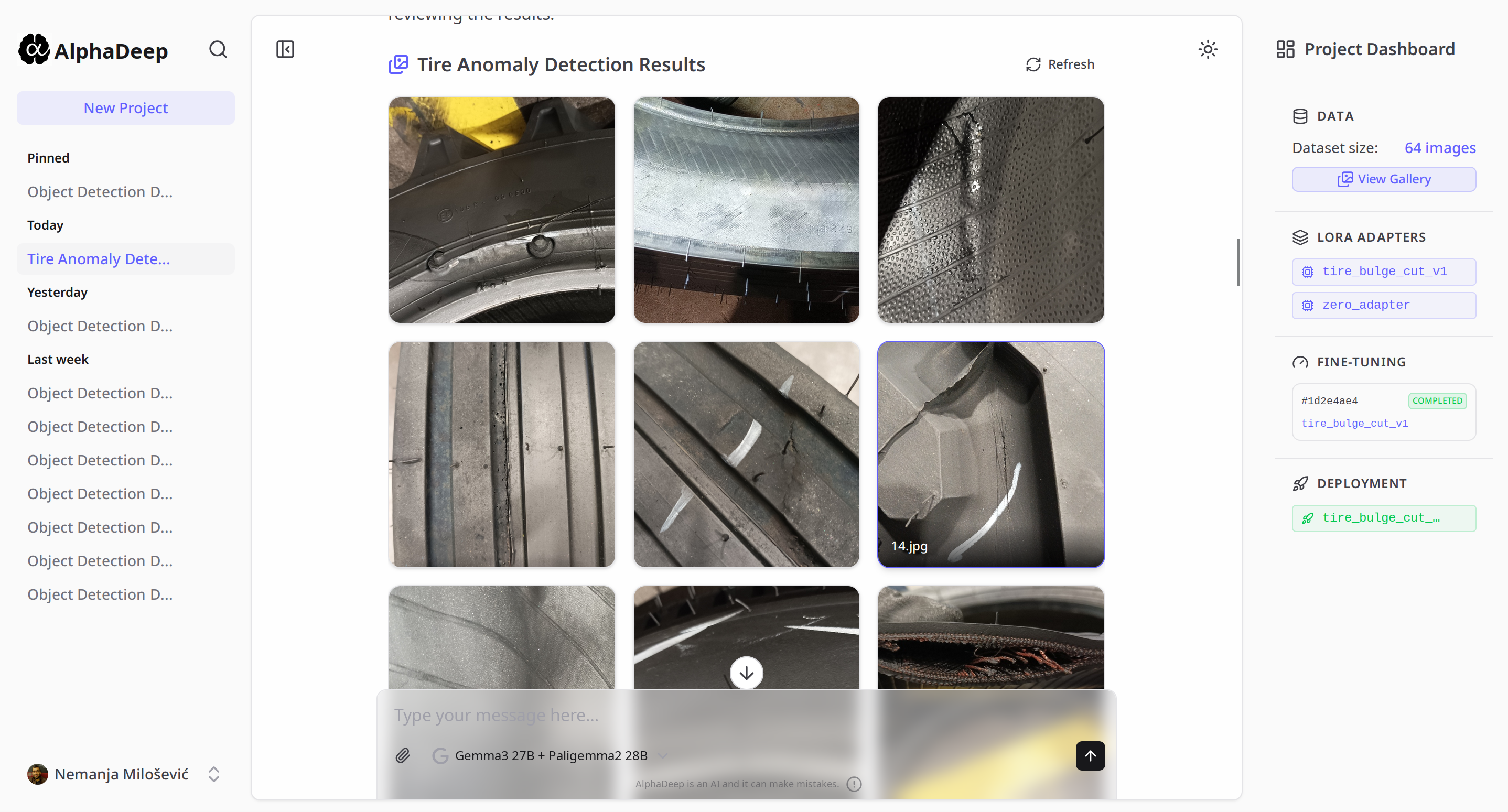
Defect Classification
Precise bounding boxes and flaw classification trained in minutes.
5. The Open Source Kernel: Blinx
We believe enterprise infrastructure must never be a walled garden. Our core serving engine, Blinx, is fully open-source and built on JAX, vLLM, and Flax. It enables zero-downtime hot-swapping of LoRA adapters on Google Cloud TPUs and NVIDIA GPUs.
Inspect the Blinx Kernel
JAX-native multi-adapter serving router on GitHub.